

Industrial Automation Company Singapore: How the Right Partner Can Transform Your Operations
Industrial Automation Company Singapore: How the Right Partner Can Transform Your Operations
Singapore has built a global reputation as one of Asia's most advanced manufacturing hubs. From semiconductors and precision engineering to food manufacturing, biomedical sciences, logistics, and electronics, businesses across the country are increasingly turning to automation to improve productivity, consistency, quality, and operational resilience.
That shift is accelerating. Singapore currently has the second-highest robot density globally, with 730 robots per 10,000 workers, according to the Singapore Economic Development Board. Industrial automation, robotics, artificial intelligence, and smart manufacturing technologies are becoming increasingly important across the factory floor. (Economic Development Board)
For manufacturers, however, investing in automation is not simply about buying a PLC, servo motor, HMI, drive, or robotic system.
The real question is: are you working with the right industrial automation company in Singapore to turn those technologies into a reliable, productive system?
An experienced automation company can help identify operational problems, select suitable technology, integrate multiple systems, commission equipment, and provide ongoing technical support.
This guide explores what an industrial automation company does, when your business may need one, and what you should consider when selecting an automation partner in Singapore.
What Is an Industrial Automation Company?
An industrial automation company helps businesses automate machinery, production processes, and industrial operations using control systems and related technologies.
Depending on the application, an automation solution may involve:
- Programmable Logic Controllers (PLCs)
- Human Machine Interfaces (HMIs)
- Servo motors and servo drives
- Variable Frequency Drives (VFDs)
- Motion controllers
- Industrial PCs
- Sensors
- Industrial communication systems
- Machine safety systems
- Control panels
- Robotics
- Industrial networking
But supplying the components is only one part of the process.
A capable industrial automation company should understand how the entire system works together.
For example, a servo motor may provide excellent performance on paper, but if it is incorrectly sized, poorly programmed, or not properly integrated with the PLC and motion controller, the machine may still suffer from poor accuracy, unnecessary downtime, or inconsistent cycle times.
This is why manufacturers should look beyond individual automation products and consider the engineering and integration expertise behind the solution.
Why Industrial Automation Is Becoming More Important in Singapore
Manufacturing remains one of Singapore's most important economic sectors. According to EDB, manufacturing accounts for around 20% of Singapore's GDP, while advanced manufacturing continues to play an important role in industries including semiconductors, biomedical sciences, aerospace, and specialty chemicals. (Economic Development Board)
At the same time, manufacturers face several challenges.
These include:
- labour constraints
- increasing operating costs
- pressure to improve production quality
- shorter delivery timelines
- higher customer expectations
- increased global competition
- the need for better production visibility
Automation helps businesses address many of these challenges.
Modern manufacturing facilities can use automation to reduce repetitive manual tasks, improve production consistency, monitor machinery more effectively, and make better use of production data.
Singapore is also increasing its focus on AI-enabled and advanced manufacturing. In 2026, the country announced further initiatives aimed at creating an AI-empowered manufacturing sector, including technologies supporting intelligent inspection, autonomous systems, industrial AI, and productivity transformation. (Economic Development Board)
For manufacturers, this means choosing automation systems that not only solve today's problems but can also support future digital transformation.
What Does an Industrial Automation Company in Singapore Do?
A good automation company typically supports businesses throughout several stages of an automation project.
Automation Consultation and System Planning
Every successful automation project should begin with understanding the process.
Before recommending equipment, an automation specialist should evaluate:
- the current production process
- existing machinery
- bottlenecks
- cycle-time requirements
- precision requirements
- operator involvement
- safety requirements
- future expansion plans
This prevents businesses from investing in technology that is unnecessarily complex or unsuitable for the application.
PLC and Control System Integration
PLCs are at the heart of many industrial automation systems.
They control machines, sequences, sensors, motors, actuators, alarms, and other processes.
An experienced automation company can help select, configure, programme, and integrate PLC systems based on the requirements of the machine or production environment.
HMI Integration
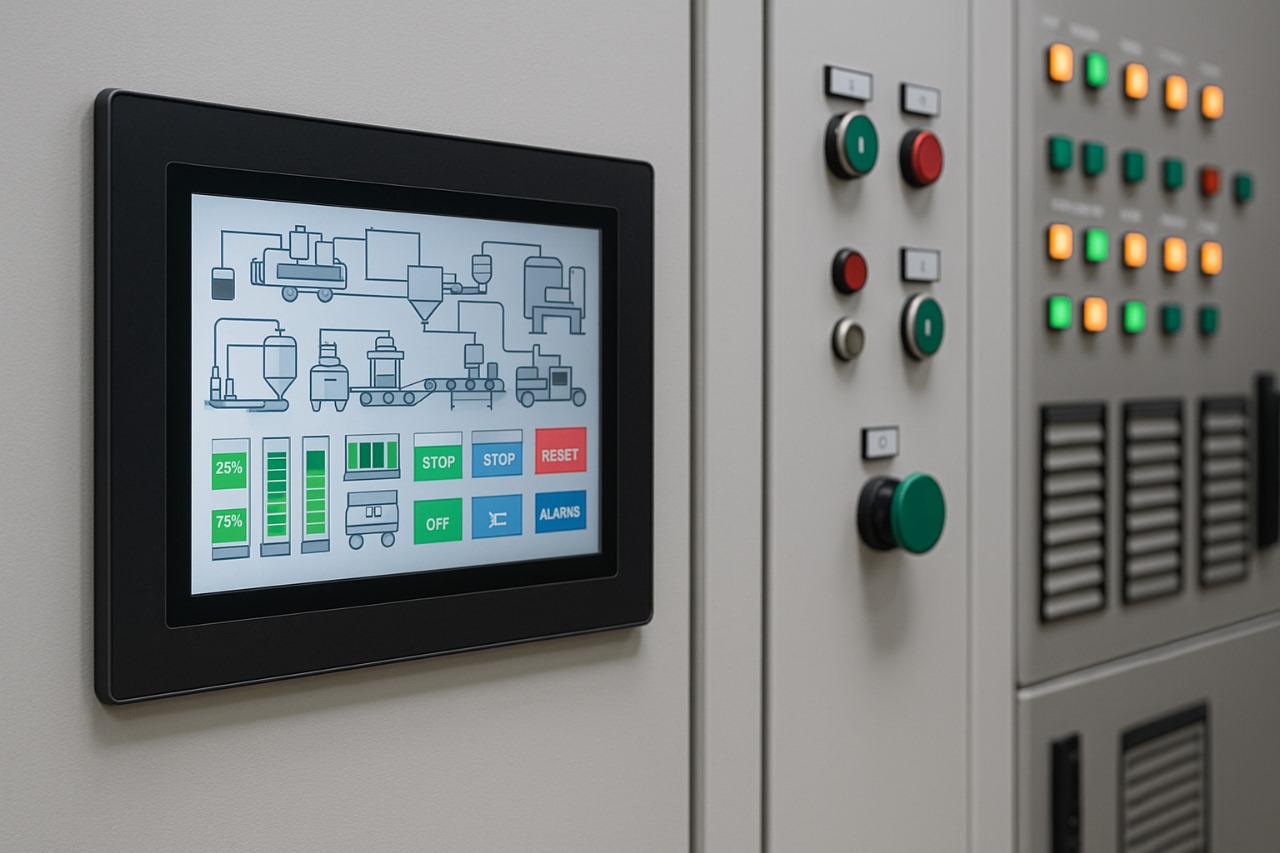
An HMI gives operators a visual interface to control and monitor machinery.
A well-designed HMI can help operators:
- monitor machine status
- adjust parameters
- identify alarms
- understand faults
- view production information
- operate machinery more efficiently
Good HMI design is not only about appearance. It should make the machine easier and safer to operate.
Servo and Motion Control
Applications requiring high levels of positioning accuracy, speed, synchronisation, or repeatability often rely on servo systems.
Servo motors and motion-control technologies can be used in applications such as:
- packaging
- positioning systems
- indexing
- pick-and-place machinery
- cutting systems
- conveyors
- assembly machinery
- printing
- material handling
Correct servo sizing, tuning, control architecture, and integration are essential for achieving reliable performance.
Drives and Motor Control
Variable Frequency Drives and other drive technologies can provide better control over motor speed and torque while also supporting efficiency and process optimisation.
An industrial automation company can help determine the correct drive configuration for each application.
Machine Integration and Commissioning
Automation components must communicate correctly with each other.
This is where system integration becomes critical.
An experienced system integrator brings together the PLC, HMI, sensors, drives, motors, networking, safety systems, and other technologies into one functioning system.
Commissioning then ensures that everything operates correctly under real production conditions.
7 Signs Your Business May Need an Automation Partner
Businesses often wait until production problems become serious before considering an automation upgrade.
There are several warning signs that indicate it may be time to speak with an industrial automation company.
- Frequent Machine Downtime
Repeated failures and unexpected stoppages can quickly affect productivity and delivery schedules.
If your production team spends too much time troubleshooting outdated systems, an automation assessment may identify opportunities to improve reliability.
- Too Much Manual Intervention
Manual processes are not always inefficient.
However, when operators repeatedly perform predictable tasks that could be automated, businesses may be losing valuable time and labour resources.
- Inconsistent Production Quality
Automation can help create repeatable processes.
Accurate control over positioning, speed, timing, temperature, pressure, and other process variables can reduce inconsistencies caused by manual operation.
- Your Control Systems Are Becoming Obsolete
Older PLCs, HMIs, drives, and controllers can become increasingly difficult to maintain.
Replacement parts may become harder to source, while technical support may become limited.
Retrofitting or modernising these systems before a critical failure can reduce operational risk.
- Production Needs to Increase
Adding more workers is not always the most efficient way to increase output.
Automation may allow businesses to increase throughput while maintaining consistent product quality.
- Limited Visibility Into Production
Modern automation systems can provide much greater visibility into machine performance, alarms, operating conditions, and production data.
This helps managers and engineering teams make better decisions.
- Your Existing System Cannot Scale
A machine may meet today's production needs but become restrictive as the company grows.
A scalable automation architecture makes future expansion easier.
How to Choose the Right Industrial Automation Company in Singapore
Choosing the right partner can have a significant impact on the long-term performance of your automation investment.
Here are some of the most important factors to evaluate.
- Look Beyond Product Supply
A supplier may be able to provide PLCs, motors, drives, and sensors.
An automation partner should also understand how those products work together.
Ask whether the company can help with:
- system design
- component selection
- programming
- integration
- commissioning
- troubleshooting
- optimisation
The goal should be to solve an operational problem rather than simply sell equipment.
- Evaluate System Integration Capability
Integration is one of the most important skills in industrial automation.
Modern machines often use components from multiple technologies and manufacturers.
A capable system integrator should understand how these technologies communicate and how to create a reliable control architecture.
When comparing automation companies in Singapore, ask about their experience integrating PLCs, HMIs, motion control, drives, industrial networking, and other control technologies.
- Check Their Experience With Established Automation Brands
Working with recognised industrial technology manufacturers can provide access to proven automation platforms and long-term product support.
However, brand availability alone is not enough.
The automation company should also understand how to configure and apply the technology correctly.
ServoConnect works across a broad range of automation and motion-control technologies, allowing solutions to be evaluated based on the needs of the application rather than relying on a single component category.
- Look for Local Technical Support
Automation projects do not end once the equipment is installed.
Machines may require:
- tuning
- modifications
- troubleshooting
- replacement components
- programming changes
- future expansion
Working with a Singapore-based automation partner can make technical communication and support easier when assistance is required.
This is particularly important for businesses where production downtime carries a significant cost.
- Choose an Application-Focused Partner
Different industries have different automation requirements.
For example, a high-speed packaging machine may prioritise motion synchronisation and cycle time.
A semiconductor application may prioritise precision and reliability.
A material-handling application may require robust motor control and coordination between multiple conveyors.
The right automation company should understand what your machine or process needs to achieve before recommending a solution.
- Ask About Scalability
Automation systems should not create unnecessary barriers to future growth.
Your partner should consider questions such as:
- Can additional machines be connected?
- Can the control architecture be expanded?
- Can production data be integrated later?
- Will future components remain compatible?
- Can the system support additional automation?
Planning for scalability can reduce the cost of future upgrades.
- Consider After-Sales Support
When comparing automation companies, price is important, but it should not be the only consideration.
A lower upfront price can become expensive if the system experiences frequent issues or support is difficult to obtain.
Evaluate the company's ability to provide ongoing engineering and technical assistance.
Industrial Automation Supplier vs Automation Solutions Partner
There is an important distinction between buying automation products and implementing an automation solution.
An automation supplier primarily provides components.
An automation solutions partner looks at the entire application.
For example:
A manufacturer may initially believe it needs a new servo motor.
However, after evaluating the application, an automation expert may determine that the real issue lies with controller configuration, drive tuning, mechanical design, or communication between systems.
That engineering perspective can prevent unnecessary spending.
The best industrial automation companies therefore operate as technical partners rather than simply equipment vendors.
The Role of Automation in Reducing Downtime
Downtime is one of the biggest concerns in manufacturing.
While automation cannot eliminate every machine failure, modern control systems can help businesses detect problems earlier and diagnose faults faster.
Automation can provide:
- machine alarms
- fault histories
- operational status
- performance information
- process monitoring
- better diagnostic information
This allows maintenance teams to respond more effectively.
Advanced manufacturing initiatives in Singapore are increasingly incorporating technologies such as data analytics, intelligent inspection, AI, robotics, and predictive capabilities to improve factory performance. EDB has highlighted examples of Singapore manufacturers using these technologies to improve productivity and reduce operational inefficiencies. (Economic Development Board)
Can Existing Machines Be Upgraded With Automation?
Yes.
Businesses do not always need to replace an entire machine.
In many cases, existing equipment can be modernised through an automation retrofit.
This may involve replacing or upgrading:
- PLCs
- HMIs
- servo drives
- motors
- VFDs
- sensors
- control panels
- communication systems
Retrofitting can extend the useful life of machinery while improving performance, usability, reliability, and maintainability.
However, every machine should be assessed individually before deciding whether retrofit or replacement is the better option.
Why ServoConnect for Industrial Automation in Singapore?
Choosing an industrial automation company is ultimately about finding a partner that understands both the technology and the application.
ServoConnect provides automation, drive, motion-control, and system-integration solutions for businesses looking to improve machine and production performance.
Rather than focusing purely on individual components, the objective is to understand the operational requirement and identify the technologies needed to create a reliable solution.
ServoConnect's capabilities span key industrial automation areas including:
- PLC and control solutions
- HMI systems
- servo motors and drives
- motion control
- variable frequency drives
- industrial control components
- machine integration
- technical support
With access to established industrial automation technologies and local engineering expertise, ServoConnect helps businesses evaluate and implement solutions suited to their individual applications.
Building Smarter, More Competitive Manufacturing Operations
Singapore's manufacturing environment is moving rapidly towards more connected, automated, and intelligent operations.
EDB notes that Singapore's advanced manufacturing ecosystem now includes widespread deployment capabilities across industrial automation, robotics, AI, and other factory-floor technologies, supported by a large ecosystem of engineering and technology providers. (Economic Development Board)
For manufacturers, that creates both opportunity and complexity.
The technology available today is more capable than ever, but achieving meaningful results requires more than selecting the latest equipment.
Businesses need systems that are:
- reliable
- appropriately designed
- properly integrated
- maintainable
- scalable
That is where the right industrial automation company adds value.
Looking for an Industrial Automation Company in Singapore?
Whether you are planning a new automation project, upgrading existing machinery, improving motion control, or replacing an ageing control system, choosing the right technical partner can make a significant difference.
ServoConnect works with businesses to identify practical automation solutions based on their applications, production requirements, and long-term objectives.
Ready to Discuss Your Automation Requirements?
Talk to ServoConnect about your next industrial automation project in Singapore.
From PLCs and HMIs to servo systems, drives, motion control, and machine integration, our team can help you identify the right solution for your application.
Contact ServoConnect today to discuss your automation requirements.
Frequently Asked Questions
- What does an industrial automation company do?
An industrial automation company helps businesses automate machinery and production processes using technologies such as PLCs, HMIs, servo motors, drives, sensors, industrial networking, and control systems. It may also provide programming, system integration, commissioning, troubleshooting, and technical support. - How do I choose an industrial automation company in Singapore?
Look for experience in system integration, relevant automation technologies, application engineering, local technical support, commissioning, troubleshooting, and long-term system support. The company should understand your operational requirements before recommending products. - What is industrial automation used for?
Industrial automation is used to improve the control, consistency, productivity, safety, and efficiency of machines and production processes. Applications include packaging, assembly, material handling, manufacturing, processing, positioning, and machine control. - What is the difference between an automation supplier and a system integrator?
An automation supplier primarily provides components. A system integrator combines technologies such as PLCs, HMIs, drives, motors, sensors, and software to create a complete working automation system. - Can old industrial machines be automated?
Many existing machines can be retrofitted with newer PLCs, HMIs, drives, servo systems, sensors, and control technologies. A technical assessment is required to determine whether retrofitting or replacement provides better long-term value. - How can automation reduce production downtime?
Automation systems can provide better diagnostics, alarms, process monitoring, repeatable control, and information about equipment performance. This can help maintenance teams identify issues more quickly and reduce unnecessary production interruptions. - Why is local automation support important in Singapore?
Local support can improve communication and response times for commissioning, troubleshooting, maintenance, programming changes, and future upgrades. - What industries benefit from industrial automation in Singapore?
Industrial automation is widely used across precision engineering, electronics, semiconductor manufacturing, food and beverage, pharmaceuticals, logistics, packaging, material handling, machine building, and many other manufacturing sectors.
📞 Talk to us: +65 6749 7419